
Dearborn Decide: Fundraising & Relationship Building with Young Residents
When working in collaboration with the City of Dearborn they expressed concern that the young residents of Dearborn were not participating in civic engagement, weren’t donating, and weren’t entering the city’s donor pipeline. From that we hoped to find ways to encourage more contribution, through monetary and in-kind donations, while also strengthening young people’s connection to their community. From that inspiration, Dearborn Decide was created. This is a community web portal designed to give every resident a meaningful voice in shaping the city’s future. Through the platform, each resident can propose one idea for an initiative, improvement, or event they would like to see in Dearborn. Their idea is then shared on a public community board where everyone can browse, read, and react to what others have posted.

How might we…
Young residents do not donate to their community through government fundraising efforts despite partaking in community-funded events. How might we inspire Dearborn’s young residents to become active donors within their community?
Preliminary Research
As a group we worked closely with the City of Dearborn’s grants department, to better understand the makeup of the community. Currently, more than 50 percent of the population is under 25 years of age and over 30 percent of their population is foreign born. The department expressed concern over the young residents of the city in that they do not participate in civic engagement, do not donate, and are not entering the city’s donor pipeline. Currently, the city depends on receiving grants and donations, but are now being more strategic about how they will get money. For that reason, Dearborn sought to investigate how to inspire young residents to build affinity for their community and become active donors. To better understand the young residents and come up with effective outreach methods, we conducted a survey and street interviews with Dearborn residents.
Survey
We conducted a survey of 95 students from a Dearborn High School to better understand how young residents view and engage with their community. This research told us another story about the problem. 70 percent of them have donated in the past 12 months, just not to the City of Dearborn with 81 percent of them detailing that their reason for donating was because it was a cause that they cared about. Additionally, only 22 percent of the respondents felt a deep connection to the Dearborn community. This shows that young residents are generous, but that there is something that holds them back from giving directly to the city.
Street Interviews
Context: We Conducted 57 user interviews across diverse Dearborn locations (UM-Dearborn, downtown, annual haunted trail) to uncover civic engagement barriers and identify desired community initiatives.
Methodology: Synthesized qualitative data using an affinity diagram to map user interests and recurring community pain points.
Key Findings
Top Desired Initiatives:
Educational and career programs for students.
Cultural festivals, concerts, and food truck events.
Social mixers and mental health/empowerment workshops.
Core Insights: Residents showed a strong readiness for civic change but expressed widespread frustration regarding a lack of trust and over-saturation of commercial spaces (e.g., redundant coffee shops). Participants highlighted a critical lack of low-cost, non-commercial entertainment for young adults beyond dining and socializing over coffee.


Initial Ideation & Thematic Evolution
With so many great ideas, it was difficult approaching the situation in a way that could encompass everything. Rather than addressing the challenge through traditional fundraising strategies, our team reframed the problem based on insights from young residents. Our research revealed that young people in Dearborn are not disengaged or unwilling to give. In fact, many already donate and actively share ideas for improving their community. The true barrier lies in a disconnect between the City’s offerings and what young residents value. Many do not feel represented, heard, or meaningfully included in existing initiatives, making donation requests feel impersonal and unmotivating. This indicated that increasing donations required rebuilding trust, fostering belonging, and creating accessible pathways for participation before asking for financial support.
Divergence & Convergence: Facilitated individual sketching sessions to rapidly generate diverse, interactive prototyping concepts tailored to the budget constraints of young residents. We then evaluated and synthesized our individual concepts to align with project goals. However, initial convergence highlighted a critical issue: aligning with the grants department's resource capacity (a lean two-person team) required significant scope refinement to ensure feasibility without compromising user value.


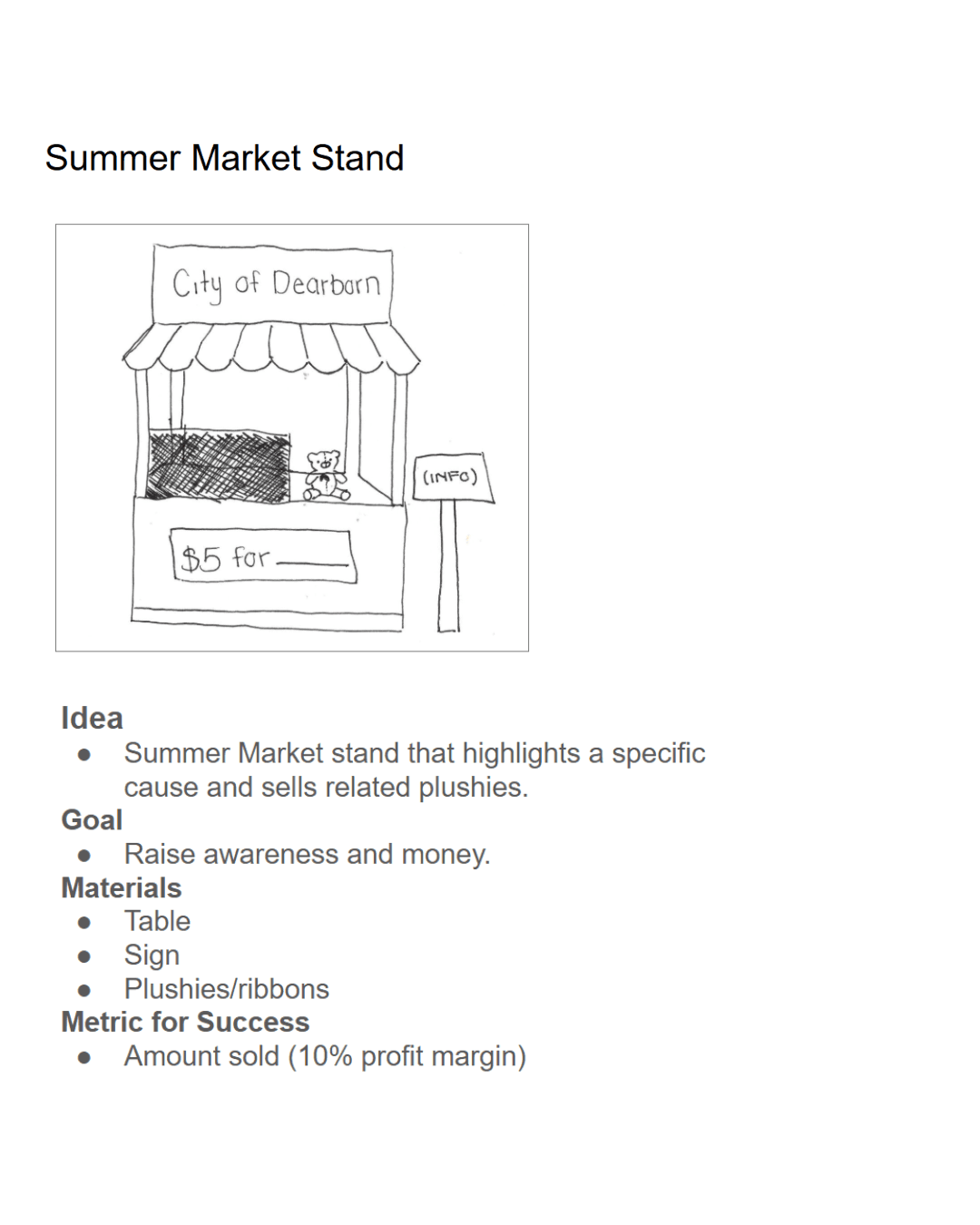
Reorganization: Conducted generative interviews with organizational leaders who rely heavily on community engagement to identify operational pain points and structural gaps. We then synthesized qualitative insights to uncover participatory budgeting—a democratic framework empowering community members to directly decide how public or organizational funds are allocated. Recognizing that traditional civic models alienate younger audiences, we conceptualized Dearborn Decide. The platform shifts the UX paradigm from transactional fundraising to continuous community participation—allowing users to ideate, vote, and micro-contribute. This design strategy turns financial support into a seamless touchpoint for civic involvement, fostering long-term civic ownership among youth."
Low Fidelity Prototype
To test our concept rapidly and evaluate physical interaction, we bypassed digital wireframes in favor of a tactile, three-section poster board prototype. The layout was structured for intuitive engagement:
Section 1 (Ideation Hub): Provided project context alongside blank sticky notes for residents to draft their own city initiatives.
Section 2 (Community Board): Acted as an open sorting space where users categorized and displayed their ideas collaboratively.
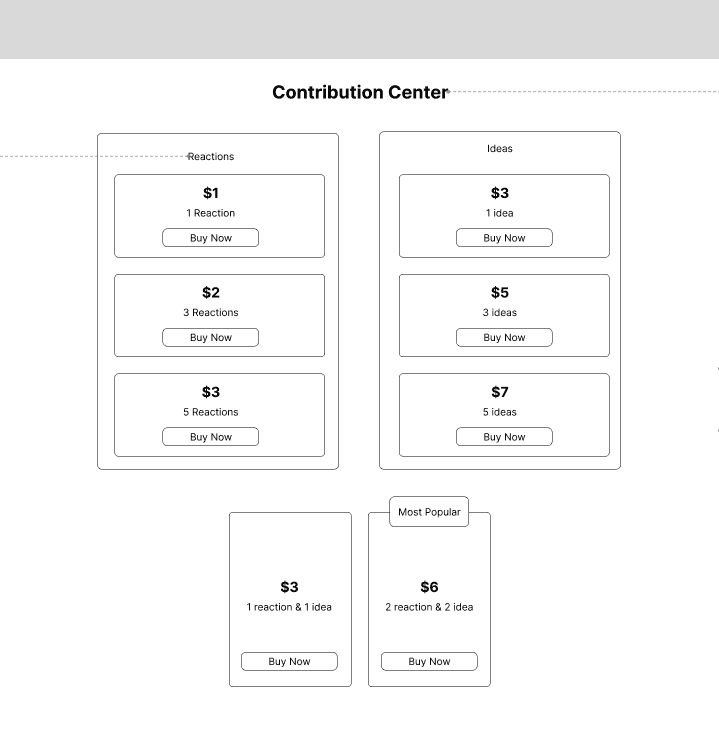
Section 3 (Value Exchange): Outlined pricing and bundle options for purchasing additional votes or idea slots.
This low-fi prototype allowed us to validate a dual-value model—giving residents a tangible voice while testing willingness-to-pay mechanisms for municipal fundraising.


User Testing
We conducted in-person usability testing at the Dearborn Public Library with 7 diverse local residents to evaluate our physical prototype. While participants strongly validated the core concept of a centralized platform for community ideation, the session surfaced critical UX friction points regarding trust, social dynamics, and cognitive load:
Aversion to 'Voting' & Monetization: The terminology around 'buying a vote' created immediate discomfort, signaling a transactional or inequitable system rather than a civic one.
Fear of Negative Social Impact: Users rejected 'downvoting' out of politeness, fearing it would discourage peer participation or come across as rude.
High Cognitive Load: Requiring users to ideate on the spot caused performance pressure, highlighting the need for low-pressure entry points.
Medium Fidelity Prototype
As the project progressed, user feedback and design evaluations led to several critical pivots aimed at improving accessibility, engagement, and information architecture for the City of Dearborn platform:
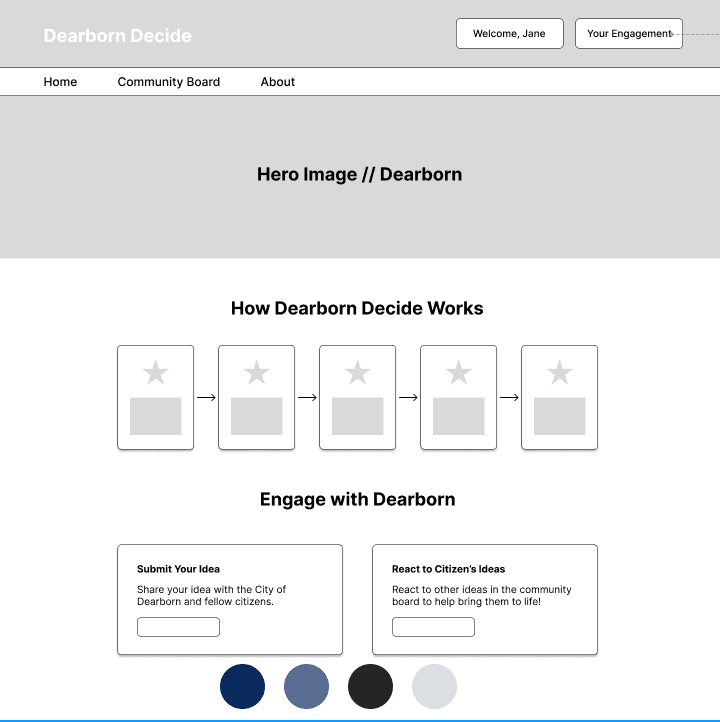
Platform Modernization: Integrated the ideation workflow directly into the City of Dearborn's official website. Moving online empowered residents to brainstorm and submit ideas asynchronously, removing the time pressures and public scrutiny typical of traditional town halls.
Simplifying User Feedback: Deprecated the traditional voting system, replacing it with intuitive thumbs-up and thumbs-down reactions. This lowered the barrier to engagement and fostered a more approachable way for users to express sentiment.
Data-Driven Overview Section: Designed a summary dashboard highlighting key metrics—including total ideas posted, total funding raised, aggregate reactions, and the top-voted idea. This allowed users to easily scan community impact at a glance and prevented information overload.

Final Concept
The final site is a centralized, accessible platform integrated directly into the City of Dearborn’s official website. It is structured around four core pillars designed to ensure transparency, security, and effortless engagement:
Accessible Digital Integration: Embedded seamlessly within the existing City of Dearborn website, ensuring residents can easily find and access the tool without navigating a separate external platform.
Secure Resident Authentication & Profile Management: Features a dedicated login page that verifies residency to maintain local integrity, while allowing users to select a custom username for anonymity. This profile system enables residents to safely edit their submissions and track their personal contributions over time.
Community Board & Discovery: A dynamic community board featuring scannable posts equipped with clear categorization, reaction counts, and robust filtering and sorting tools. This layout allows users to quickly browse proposals and gauge community interest at a glance.
Transparent Contribution Center: A dedicated financial hub that provides clear, explicit breakdowns of how funds are utilized. Contributions made by residents go directly toward supporting the top-voted community initiative, fostering trust and direct civic impact.


Reflection
Our research focused on young adult residents between the ages of 15-24 who live in the City of Dearborn. Due to this, we focused on the community-facing aspects of the platform. For Dearborn Decide to be effective, the government-facing interactions would need to be built into the prototype and finalized system. Future research with City of Dearborn government officials would allow a deeper understanding of their needs and directly inform features and interactions made available to them in Dearborn Decide.
If the system were developed, government users would need these capabilities:
Review submitted ideas
Access and manage donated funds
Communicate with Dearborn Decide participants
Government officials need the ability to review ideas submitted by citizens, as well as add or remove ideas prior to their population on the community idea page. This would ensure that idea submissions aren’t inappropriate or unable to be funded by the government due to partisan political or religious affiliation. In addition, officials will need to access and organize funds donated on the platform. Additional research should be conducted to determine where the funds could remain during the nine-month cycle when Dearborn residents can submit their ideas and reactions.
Furthermore, the City of Dearborn would need communication features to establish transparency and rapport with participants. Upon the completion of a cycle, officials would need to message all participants, thanking them for their engagement and funding. After selecting an idea with high levels of funding or support, officials would need the ability to communicate with the resident who submitted the winning idea. The participant could then work directly with government officials to clarify their idea, and garner additional funding or support from their network of community members if needed. This process is another opportunity for the City of Dearborn to build their donor pipeline, establishing lasting relationships with participants and volunteers who are interested in Dearborn Decide.