
Recycling with AR: Making sustainable habits easier through real-time guidance
Imagine you are a student from the U.S. in Korea. You drop a bottle in a "recyclable" bin, only to be stopped. Labels and bottles must be separated. Rules change. Confusion is universal.
People often struggle with correct recycling in unfamiliar environments. Sorting rules vary across regions, and unclear instructions lead to confusion and contamination.
Despite the fact that 94% of people currently take recycling initiatives and 75% of waste is recyclable, the majority of that waste is contaminated with incorrect items, ultimately making it unrecyclable (Williamson).
Despite high support, inconsistent rules lead to massive cross-contamination and waste.
Recycling with AR is an app that guides users on how to take action against waste items, by carefully instructing how to properly dispose of them.

How might we…
How might we use AR to give users instant and clear guidance on proper waste sorting?
Preliminary Research
A competitive analysis revealed major gaps in current solutions:
Smart Bins: Efficient at sorting, but feature-prohibitive hardware, high maintenance, and poor scalability.
Educational Programs: Offer deep learning, but require scheduled time and are unavailable at the “moment of action.”
Standard Apps: Inexpensive and informational, but text-heavy, rarely region-specific, and impractical for users in a rush.
Key Takeaway
Existing tools either fail to deliver guidance at the precise moment of decision or rely on expensive hardware, highlighting a need for a scalable, fast, and region-specific digital solution.
User Interviews
To understand cross-cultural habits and waste-management realities, I interviewed 5 participants—4 foreign-born individuals and 1 custodial worker.
Cross-Cultural Insights: Participants from countries with strict mandates (like South Korea) demonstrated significantly better recycling habits due to ingrained, standardized education. In contrast, U.S. recycling guidance is viewed as fragmented and confusing.
Custodial Perspective: The custodian revealed that a single contaminated item ruins an entire bin, resulting in most recycling and compost being redirected to landfills due to constant user error.
Key Insight: The core issue isn't a lack of user intent, but a systemic failure of clear, immediate guidance. Without standardized rules and real-time education at the bin, well-intentioned users will continue to accidentally contaminate entire waste streams.
Initial Ideation & Thematic Evolution
Brainstorming: We explored multiple directions during individual brainstorming
Smart bins with sensors
Gamified mission systems
Community reward systems
Learning modes and recycling maps
Why not these?: These problems were either too expensive, too complex, or did not directly solve the moment-of-action recycling problem, thereby straying away from our how might we statement.
Final Design Proposal: Ultimately, the final concept chosen was real-time AR recognition with localized instructions for the following reasons:
Low hardware cost compared to smart bins.
Works instantly at the moment of recycling.
Helps users navigate different regional rules.
Clear, visual guidance reduces mistakes.


Low Fidelity Prototype
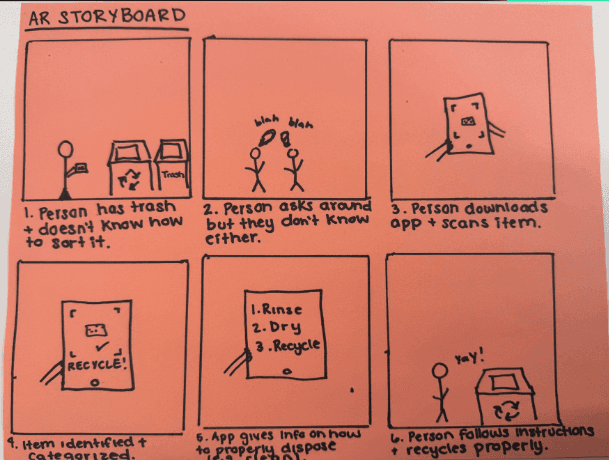
Storyboards & Sketches: To visualize a more concrete idea, early sketches helped with visualizing basic scanning flow and instructions.
Physical Prototype: Determined whether or not it this idea would be feasible and simple to use for a person on the go. It also allowed us to define three key interactions.
Interaction One: Scan the item.
Interaction Two: Identify if recyclable or not recyclable.
Interaction Three: Show localized guidance.

Design Feedback & Iterations
1. Platform Strategy: Smartphones vs. AR Glasses
Feedback: “Why not design for AR Glasses, given they represent the future of technology?”
UX Rationale & Pivot: While AR glasses are an emerging medium, they currently remain niche and cost-prohibitive. To ensure immediate scalability and a higher impact, we prioritized smartphones—leveraging ubiquitous mobile access to reach a significantly broader percentage of the population right away.
2. Target Audience Refinement
Feedback: “Is the initial audience scope too broad?”
UX Rationale & Pivot: We narrowed our focus from general consumers to travelers in unfamiliar environments. This specific user group frequently encounters “recycling confusion” due to navigating complex, localized disposal rules.
3. Balancing Incentives and User Motivation
Feedback: “Do reward systems risk attracting the wrong user segments?”
UX Rationale & Pivot: Stakeholders raised concerns that introducing gamification and financial rewards might attract transaction-driven users rather than genuinely eco-conscious ones. Based on this feedback, we removed the reward system to keep the core experience focused on intrinsic motivation and effortless utility.
Final Concept
The final concept is a centralized platform that demonstrates scanning, material recognition, and localized recycling instructions.
Location-Tracking: The app keeps tracks of a users location in order to find the correct recycling steps for a waste item.
Scanning: Real-time scanning of waste that will identify what it is, without having to insert any additional information.
Instructions: Users can choose to read additional instructions on items that require more than one step for recycling.
Reflection
It is essential to understand the platform one intends on using for their application and determine why it is the best fit and why it stands out from other solutions.
Having a specific user in mind allows designers to tailor their product to the users specific needs, preferences, and point points.
Brainstorming encourages creativity and innovation.
It essential to consider the usability and feasibility of the product. For example:
When can it be used?
Is it convenient?
Is it easier to use then the current solutions?
What benefits does it provide?
Get Athos Pro