The Commons: Rental Transparency in Washtenaw County
For over a century, U.S. tenants have fought for equitable housing, a struggle intensified after WWII when discriminatory administration of GI Bill benefits enabled white families to buy suburban homes while blocking veterans of color. This systemic exclusion left city centers with shrinking tax bases and deteriorating living conditions, fueling a nationwide fight for rent control that peaked in Michigan during the mid-1980s. As cities like Southfield and Ann Arbor debated local rent ordinances, fierce opposition from landlords and leaders like Senate Majority Leader John Engler culminated in the State House voting to block the measures, arguing they would stifle housing development. Finally, in July 1988, following heavy pushing from Detroit’s most influential lobbying firms, Governor James Blanchard signed a statewide ban prohibiting local governments from regulating rent—a law that remains in effect today.

How might we…
How might we provide current and prospective tenants in Washtenaw County a pathway to rental transparency that empowers them to make housing decisions?
How might we offer digital spaces for current renting communities to discuss local concerns and support one another?
Preliminary Observations
Before conducting user research, our team completed a competitive analysis to map the rental landscape, evaluate transparency, and identify market gaps. We categorized competitors into three tiers:
Tier 1 (Direct - RentZed, RealRents, JustFix): Dedicated to rental transparency and tenant rights, but hampered by restrictive UIs, missing historical data, or incomplete fee breakdowns.
Tier 2 (Indirect - Zillow, Apartments.com, Craigslist): Dominant listing platforms that favor landlord marketing over renter transparency, obscuring hidden fees and pricing histories.
Tier 3 (Partial - Reddit, Facebook, Google Reviews): Provide trusted, authentic peer insights but lack organized, location-specific housing data.
Key Opportunities:
Centralized Transparency: Fill the gap for a tool that reveals true housing costs, tracks rent histories, and holds landlords accountable.
Structured Community: Harness the authentic social proof renters trust within a structured, searchable format.
Data Privacy: Build user trust through strict privacy controls for sensitive financial and location data.
Survey
We designed and distributed a digital survey to investigate tenants’ needs, pain points, and experiences while living in Washtenaw County. We received 20 total responses, with 16 of the participants living in Ann Arbor and the remaining respondents living in Ypsilanti or Saline. While the geographical and demographic breadth is limited for these results, it serves as a starting point for understanding rental transparency needs. Overall, respondents indicated common concerns of high rent, rent increases each year, and lacking maintenance. For instance, 75% of respondents shared their desire for their rent to be lowered, and rent increases were as high as $200. In addition, 19 out of 20 respondents reported using online search platforms to find housing options, but about 55% expressed their need for hearing other people’s housing experiences when assessing their options. This finding suggests that peoples’ housing search process requires human perspectives for authentic context, but current search platforms lack in this area.


User Interviews
As a last stage of our formative research, we conducted eight user interviews with two types of users: current Washtenaw County tenants and local tenant organizers. For the first group, these semi-structured interviews focused on their current living experience, including pricing, living conditions, and management, as well as their most recent housing search process. Meanwhile, the interviews with tenant organizers inquired about current pressing issues, how they approach tenants and landlords, and what barriers they’ve faced. Across the tenant interviews, participants shared concerns about the quality of their units, with some mentioning mold or grease in vents. Additionally, most of the student interviewees expressed satisfaction with the responsiveness of maintenance, but tenant organizers—who work alongside more long-term tenants—reported the opposite. Participants also mentioned hidden fees, unexpected rent increases, and pressure from landlords to renew their lease. Similarly, interviewees expressed that they don’t feel a sense of power against their landlord, making them feel largely subordinate to their management. Regarding the housing search process, tenants largely leveraged online search platforms to explore their options; however, they implied that they had limited choices for finding quality housing beyond these platforms. Between the stories from tenants and tenant organizers, the need for quality assurance, transparency of pricing and living conditions, and greater power against landlords became evident.
"Legislative wins or getting demands met are important roles, but I have seen a lot of 'wins' that haven't built organization or created consciousness, but a lot of losses that have."
(Participant 5)
Initial Ideation & Thematic Evolution
Our ideation evolved from a broad exploration of civic engagement into a user-centered platform. By examining topics like media literacy and immigration, we ultimately prioritized housing and tenant empowerment due to rising rents and stagnant living conditions.
Research Insights & Final Design Proposal:
Following preliminary research and survey data, we brainstormed diverse design features on Miro and narrowed our focus to three distinct concepts:
Forum Based Platform: For peer-to-peer discussion and crowd-sourced knowledge.
Legal Based Guide: To simplify complex tenant rights and housing laws.
Trend-Based Guide: To visualize rental price history and landlord ratings.
Research Insights & Final Design Proposal:
Through qualitative user interviews, thematic coding, and affinity mapping in FigJam, we synthesized our findings into target personas and scenarios. The data revealed that renters needed a holistic tool rather than a single-feature solution. Our final proposal is a comprehensive, renter-facing platform tailored for Washtenaw County that synthesizes all three initial concepts. By combining centralized rent transparency data, peer discussion forums, and structured legal resources, the platform provides tenants with the visibility and collective agency needed to navigate the housing crisis and hold landlords accountable.


Low & Medium Fidelity Prototype
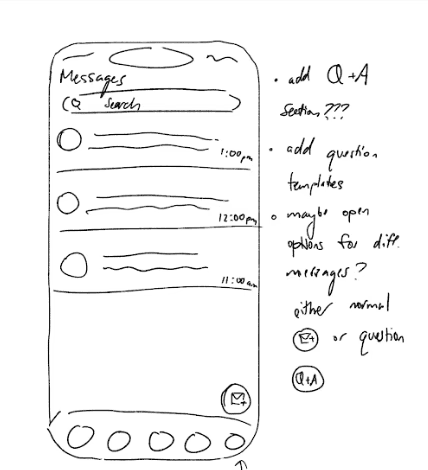
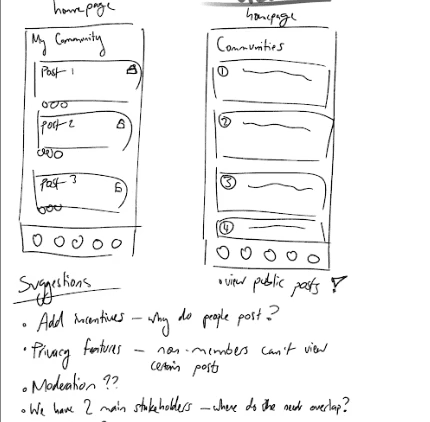
With our collected user interview insights, our team shifted into ideating and designing a mobile platform for housing seekers and current tenants in Washtenaw County to connect with their communities and access transparent information. This was a big discussion as this would expand our target stakeholders from prospective tenants into them and current tenants. We came to this realization after realizing that if prospective tenants wanted to have access to information from real people, we would also have to target current tenants in order to motivate them to use the platform as well. From there, we largely worked on hand-drawn sketches together to try and devise a seamless experience for the platform. We pulled different features and elements from individual sketches until we felt comfortable enough to begin working on our medium-fidelity prototype. The wireframes were divided into different sections in order to evenly distribute the design to each member. This division allowed each member to focus on a specific user flow to make sure that the tasks are completed in the correct order. It also streamlined the process by making responsibilities more clearly defined. Throughout this process, we maintained consistency by regularly checking in as a group, aligning on designed patterns.


Usability Testing & Refinements
With our collected user interview insights, our team shifted into ideating and designing a mobile platform for housing seekers and current tenants in Washtenaw County to connect with their communities and access transparent information. This was a big discussion as this would expand our target stakeholders from prospective tenants into them and current tenants. We came to this realization after realizing that if prospective tenants wanted to have access to information from real people, we would also have to target current tenants in order to motivate them to use the platform as well. From there, we largely worked on hand-drawn sketches together to try and devise a seamless experience for the platform. We pulled different features and elements from individual sketches until we felt comfortable enough to begin working on our medium-fidelity prototype. The wireframes were divided into different sections in order to evenly distribute the design to each member. This division allowed each member to focus on a specific user flow to make sure that the tasks are completed in the correct order. It also streamlined the process by making responsibilities more clearly defined. Throughout this process, we maintained consistency by regularly checking in as a group, aligning on designed patterns.
Final Concept
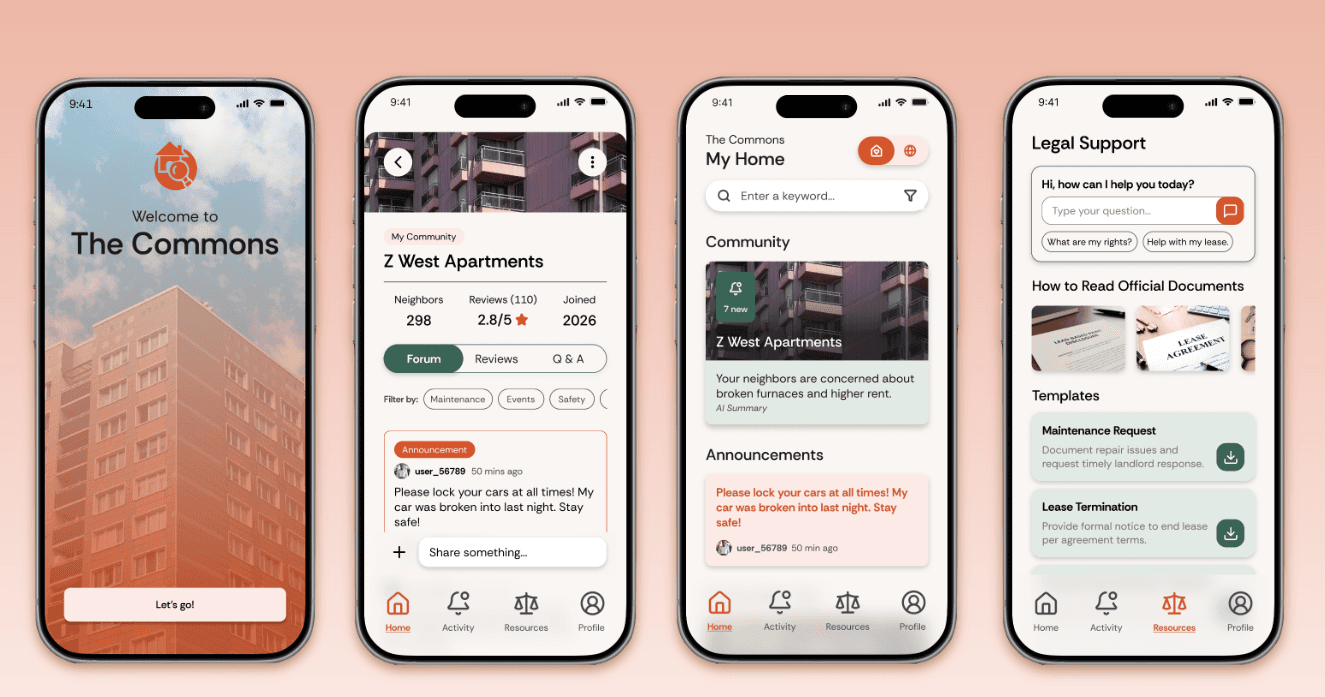
The Commons is a mobile application that aims to empower renters in Washtenaw County, Michigan, through human-first support and transparent information.
Flexible Homepage: Users toggle seamlessly between a "Tenant View" (to join forums, answer Q&As, and write reviews) and a "Prospecting View" (to compare properties, pin favorites, and ask questions).
Community Platform: Landlord-free spaces foster direct tenant-to-tenant connection and honest feedback for housing seekers.
Resources: Feature lease-demystifying articles, downloadable templates for management requests, and a private AI chatbot that safely answers personal legal questions regarding tenant rights.